Why We Chose Zeno's Conscience
Zeno's Conscience is proof that a great novel does not need a receptive audience to be great. It just needs one reader who understands what it is doing.
Italo Svevo published the book in 1923, funding it himself after his first two novels were largely ignored by Italian critics and readers. Zeno's Conscience fared no better at first. It might have disappeared entirely if Svevo had not spent time tutoring a young James Joyce in English years earlier. Joyce read the novel, recognized what Svevo had done, and personally brought it to the attention of French critics. From there, its reputation slowly grew until it became recognized as one of the defining novels of European modernism.
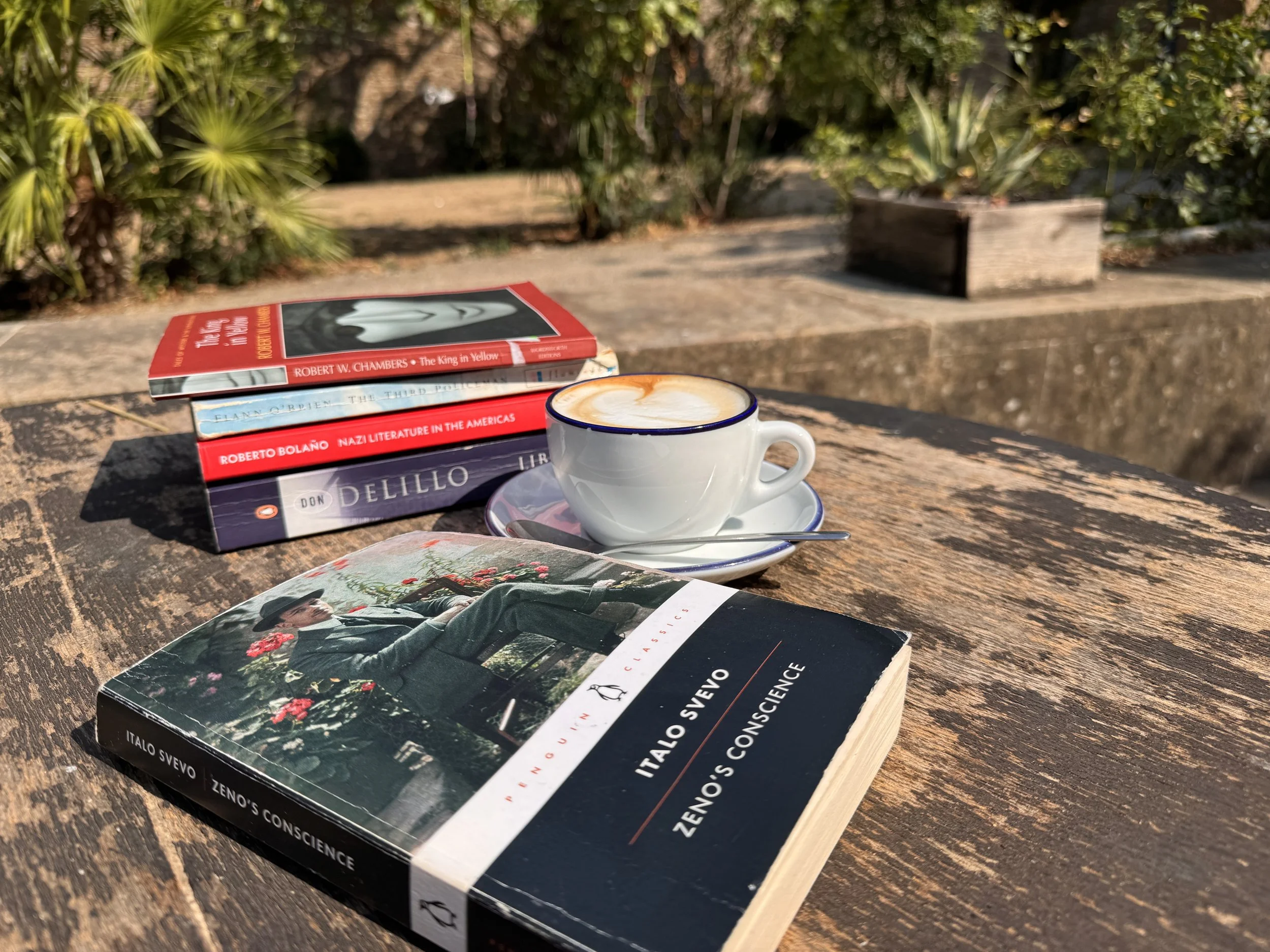
What Svevo built is a novel narrated entirely by a man who cannot be trusted to tell his own story straight. Zeno Cosini writes his memoirs at the request of his hated psychoanalyst, covering his repeated failed attempts to quit smoking, his awkward courtship of one sister followed by his marriage to another, and his erratic career in business. Zeno constantly excuses himself, reshapes events in his own favor, and reveals far more about his self-deception than he intends to. Reading the novel means constantly reading against the narrator, watching the gap between what Zeno claims and what actually seems to have happened.
We chose this book because that technique, an entire novel structured around an unreliable narrator's therapeutic self-examination, was genuinely new when Svevo wrote it, and it remains one of the clearest, funniest examples of the form. Studying Zeno's Conscience gives readers direct insight into how psychoanalytic thinking shaped early 20th Century fiction and how narrative voice alone can carry the entire weight of a novel's meaning. It is also, simply, one of the funniest serious novels of its era, and that combination of comedy and psychological precision is rare enough to be worth studying closely.
Download the Unseen Summaries guide to Zeno's Conscience and study one of modernism's sharpest portraits of self-deception.