Why We Chose The Third Policeman
Most lists of great 20th Century novels leave out The Third Policeman. That has always struck us as a mistake worth correcting.
Flann O'Brien wrote the book in 1939 and 1940, hot off the success of At Swim-Two-Birds. His publisher rejected the novel, reportedly finding it too strange even by O'Brien's standards. O'Brien was embarrassed enough that he told friends he had lost the manuscript. It sat in a drawer for the rest of his life and only appeared in print in 1967, a year after he died. That history alone makes it an interesting case study in how a major work can nearly disappear.
But the reason we chose The Third Policeman goes beyond the story of its publication. The Third Policeman is genuinely strange in a way that still feels ahead of its time. The narrator murders a man, then spends the rest of the novel navigating a parish run by policemen whose worldview is built on invented physics, endless bureaucracy, and a theory that men who spend too much time on bicycles start to become part bicycle. Threaded through the main narrative are footnotes on de Selby, a fictional philosopher whose theories are quoted at length and taken with total seriousness by the narrator, even as they grow more absurd. It is one of the earliest and sharpest parodies of academic footnoting in English fiction.
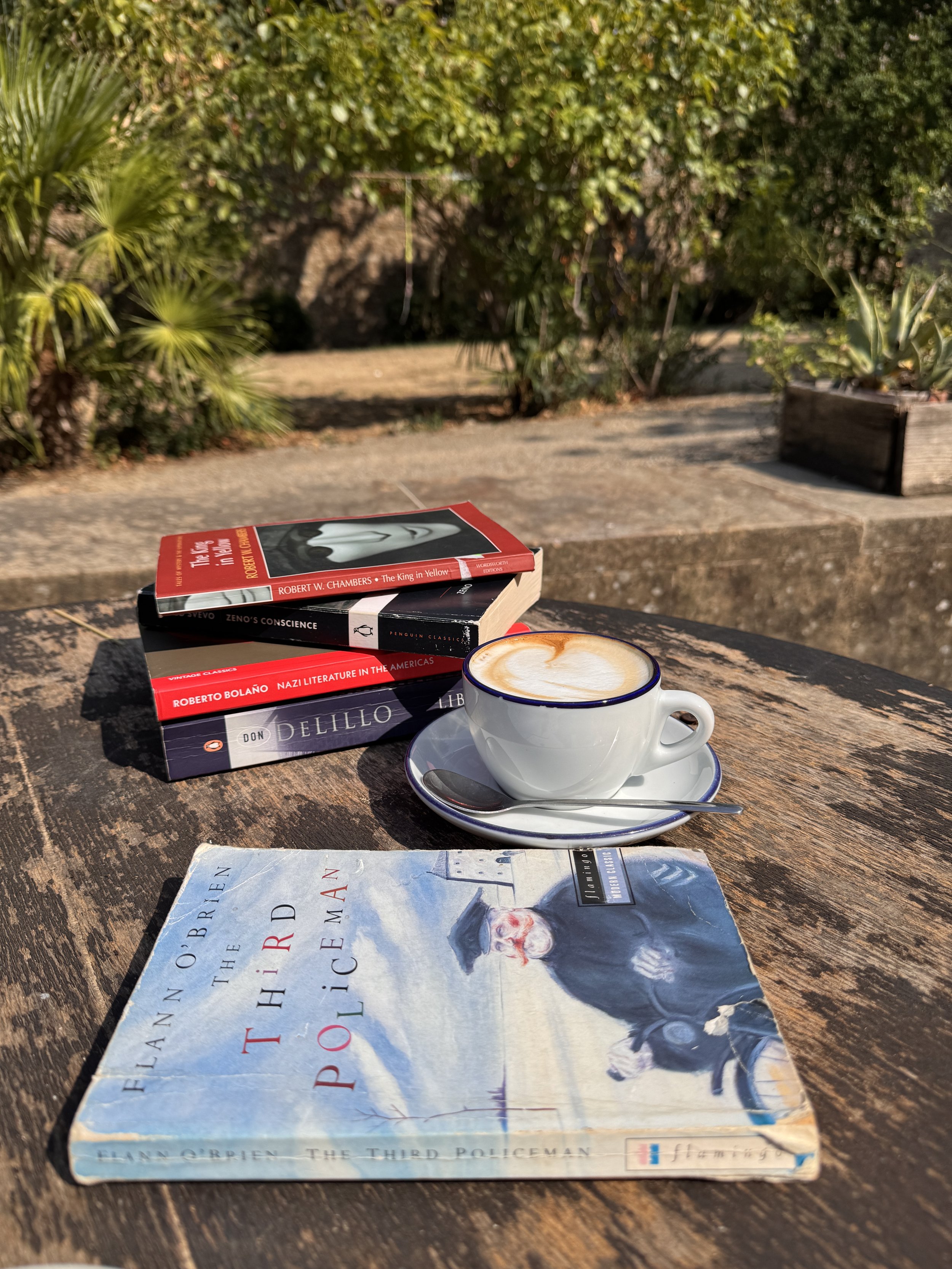
What makes the book worth studying is how deliberately structured it is. Nothing in the final chapters is accidental and readers who go back to the start after finishing the novel see it differently. That kind of structural ambition puts O'Brien in conversation with writers like Beckett and, later, Borges and Calvino, even though he wrote in relative obscurity for much of his career. Borges himself praised O’Brien’s work, as did the Welsh poet Dylan Thomas, who described At Swim-Two-Birds as “just the book to give your sister – if she’s a loud, dirty, boozy girl.” The Third Policeman continues - and even goes beyond - what O’Brien achieved in his earlier novel.
The Third Policeman also matters because it shows how a genuinely original book can be ignored by the literary establishment of its own moment and still find an audience later. That makes it a useful text for anyone thinking about how reputations get made in literature and why the canon does not always get it right the first time. We think it deserves a place on any serious reading list, and we built our guide to help readers see exactly why.
Download the Unseen Summaries guide to The Third Policeman and work through its logic, its jokes, and its philosophy with a clear, structured companion.